
How to Use Traps and Barriers in Your IPM Strategy
 Trevor Dixon
1. Introduction
The most effective pest control often begins without reaching for a spray bottle.
Integrated Pest Management, commonly known as IPM, is built upon the principle of using multiple complementary strategies to maintain pest populations below damaging levels. Among its most practical and environmentally responsible tools are traps and physical barriers. These deceptively simple devices interrupt pest life cycles, prevent infestations, and provide valuable information about pest activity.
Rather than reacting after damage has occurred, traps and barriers allow gardeners to stay one step ahead. They transform pest management from a reactive battle into a carefully orchestrated system of prevention and observation.
2. Understanding Traps and Barriers
Although often discussed together, traps and barriers perform different functions.
What Are Traps?
Traps are designed to monitor, attract, capture or reduce pest populations. Some use colour to attract insects, while others rely on pheromones, food scents or light.
Monitoring traps reveal when pests first arrive, allowing intervention before populations explode. Mass trapping can also reduce breeding numbers for certain species.
What Are Physical Barriers?
Barriers physically prevent pests from reaching plants.
Fine insect mesh, floating row covers, fruit bags, collars around seedlings and copper tape all create obstacles that insects, slugs and other pests cannot easily overcome.
Unlike pesticides, barriers do not rely on toxicity. They simply deny access.
Why They Work Together
Barriers prevent infestation.
Traps monitor and reduce populations.
Combined, they provide one of the strongest foundations of an effective Integrated Pest Management program.
3. Types of Traps for Different Garden Pests
Different pests require different approaches.
Sticky Traps for Flying Insects
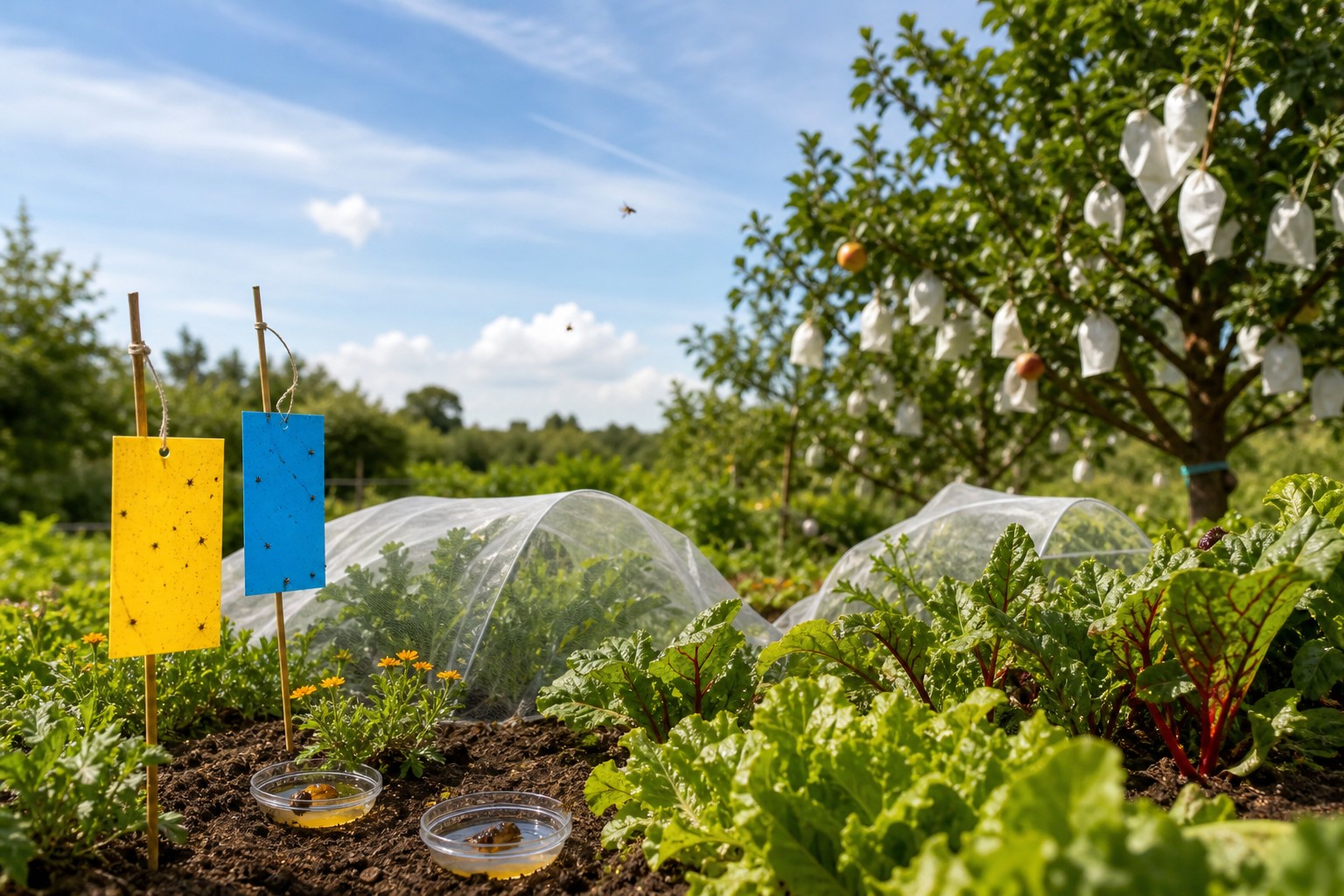
Bright yellow sticky traps attract many sap-feeding insects including whiteflies, fungus gnats, leaf miners and aphids.
Blue sticky traps are particularly effective for monitoring thrips.
Placed correctly, these traps provide an early warning system while capturing numerous adult insects before they reproduce.
Pheromone Traps for Moths and Fruit Flies
Pheromone traps use species-specific scent compounds to lure male insects.
These traps are particularly valuable for monitoring codling moths, fruit flies and other economically important pests. Because they target specific species, they minimise impacts on beneficial insects.
Beer Traps for Slugs and Snails
One of gardening's oldest techniques remains surprisingly effective.
Containers sunk into the soil and partially filled with beer attract slugs and snails, which fall into the liquid. While not a complete solution, beer traps reduce local populations and provide useful monitoring information.
Light Traps and Monitoring Devices
Some nocturnal insects are attracted to specialised light traps.
Although commonly used in commercial agriculture, smaller versions can assist home gardeners in identifying pest activity and seasonal emergence patterns.
4. Using Physical Barriers Effectively
Barriers provide continuous protection when installed correctly.
Insect Netting
Fine insect exclusion mesh prevents fruit flies, cabbage butterflies, whiteflies and numerous other pests from accessing crops.
Mesh should be installed before pests arrive rather than after infestation has begun. Every opening must be sealed carefully because even small gaps become entry points.
Fruit Bags and Tree Sleeves
Individual fruit bags made from paper, cloth or fine mesh create miniature protective shelters around developing fruit.
This technique is particularly valuable for mangoes, guavas, citrus, peaches, tomatoes and other fruit susceptible to fruit fly attack.
Copper Tape for Slugs and Snails
Copper creates a mild electrical reaction when slugs and snails contact it.
Applied around raised beds, pots and greenhouse benches, copper tape acts as a long-lasting deterrent without harming beneficial organisms.
Tree Bands and Sticky Bands
Sticky bands wrapped around tree trunks intercept crawling insects, ants and caterpillars before they reach foliage and developing fruit.
They also prevent ants from protecting sap-feeding insects such as aphids and scale.
5. Placement, Timing and Maintenance
Even the best equipment fails when poorly positioned.
Positioning Traps Correctly
Place traps at the height where target pests are most active.
Fruit fly traps perform best within tree canopies.
Sticky traps should remain slightly above crop height as plants grow.
Avoid placing traps directly beside flowering plants where beneficial insects may also be attracted.
Installing Barriers Before Infestations
Prevention is considerably easier than cure.
Install exclusion netting before flowering finishes or before fruit begins to develop. Waiting until pests are visible often allows eggs to be laid before protection is in place.
Cleaning and Replacing Equipment
Traps lose effectiveness when covered with dust, insects or debris.
Inspect them regularly.
Replace sticky surfaces when full.
Repair torn netting immediately.
Small maintenance tasks prevent large pest problems.
6. Integrating Traps and Barriers with Other IPM Techniques
Physical controls become even more powerful when integrated with complementary strategies.
Combining with Biological Controls
Beneficial insects such as ladybirds, lacewings and parasitic wasps continue controlling pests inside protected gardens.
Because barriers minimise pesticide use, these natural predators flourish.
Supporting Beneficial Insects
Flowering herbs, native plants and nectar-rich species provide food for predators and pollinators.
Maintaining biodiversity strengthens the entire pest management system.
Cultural Practices That Enhance Success
Good sanitation, crop rotation, healthy soil and correct irrigation reduce pest pressure before traps or barriers become necessary.
Each practice supports the others.
7. Common Mistakes to Avoid
Even experienced gardeners occasionally undermine their own efforts.
Over-Reliance on Traps
Traps alone rarely eliminate established infestations.
They are monitoring and management tools—not miracle cures.
Incorrect Barrier Installation
Poorly secured netting often allows insects underneath.
Loose fruit bags expose developing fruit.
Careful installation determines success.
Poor Monitoring Habits
Installing traps and forgetting about them defeats their purpose.
Frequent inspection provides valuable information that guides future decisions.
Observation is as important as intervention.
8. Seasonal Strategies for South East Queensland
Spring Preparation
Install traps early.
Inspect emerging plants frequently.
Protect vulnerable seedlings with exclusion barriers before pest populations increase.
Summer Protection
Peak insect activity demands increased vigilance.
Maintain netting, empty traps regularly and harvest fruit promptly to reduce breeding opportunities.
Autumn Clean-Up
Remove infested fruit.
Repair damaged barriers.
Store reusable equipment after cleaning.
Reduce overwintering pest populations through good garden hygiene.
Winter Maintenance
Service equipment.
Replace worn netting.
Plan next season's trap locations based on previous observations.
Preparation during quiet months creates success during busy ones.
9. Long-Term Benefits of Physical Pest Control
The benefits extend well beyond individual harvests.
Reduced pesticide applications preserve beneficial insects and soil biology.
Fruit quality improves.
Garden biodiversity increases.
Perhaps most importantly, gardeners gain confidence by understanding pest behaviour rather than simply reacting to it.
Every season becomes a learning opportunity.
10. Conclusion
Integrated Pest Management succeeds because it embraces multiple solutions rather than searching for a single perfect answer.
Traps provide intelligence.
Barriers provide protection.
Together they form a remarkably effective defence against many common garden pests while preserving beneficial insects and maintaining ecological balance.
The healthiest gardens are not those where every insect has disappeared.
They are the gardens where nature, thoughtful management and practical prevention work together in quiet harmony.


