How to Use Australian Natives for Privacy and Windbreaks
 Trevor Dixon
Introduction
A garden should feel like a sanctuary. It should provide a sense of calm, soften unwanted views, and offer protection from relentless winds without feeling enclosed. While fences and walls can create boundaries, they often lack warmth, movement, and ecological value.
Australian native plants offer a far more captivating solution.
With their remarkable diversity of textures, colours, and growth habits, native trees and shrubs can create living walls that provide privacy, reduce wind, support wildlife, and enhance the beauty of your landscape. Better still, they are naturally adapted to Australia's conditions, making them resilient, sustainable, and rewarding to grow.
Whether you're shielding a suburban backyard, protecting an exposed coastal property, or creating a tranquil outdoor retreat, native plants deliver both functionality and enduring beauty.
Understanding Privacy Screens and Windbreaks
Although they are often discussed together, privacy screens and windbreaks perform slightly different roles.
A privacy screen is designed to block views between neighbouring properties or conceal unsightly structures. Density is the primary objective.
A windbreak, however, works differently. Rather than stopping the wind completely, an effective windbreak slows and filters airflow. Solid barriers often create turbulence on the sheltered side, while layered vegetation gently redirects wind over the protected area, creating a far more comfortable microclimate.
The most successful gardens combine both functions into one elegant planting.
Choosing the Best Australian Native Plants
Selecting suitable species depends on your available space, desired height, soil conditions, and local climate.
Fast-Growing Screening Shrubs
Dense shrubs quickly establish privacy while providing year-round foliage.
Excellent choices include:
- Westringia for compact, drought-tolerant hedges
- Callistemon varieties for colourful flowering screens
- Lemon-scented Tea Tree for fragrant foliage
- Grevillea cultivars that attract nectar-feeding birds
These shrubs respond well to regular tip pruning, becoming increasingly dense over time.
Medium-Sized Trees
Where additional height is required without overwhelming the garden, medium-sized native trees create excellent privacy.
Popular selections include:
- Flax-leaf Paperbark
- Forest She-oak
- Lilly Pilly varieties
- Tuckeroo
These species produce layered foliage that softens boundaries while creating valuable habitat for native wildlife.
Tall Windbreak Trees
For larger properties, taller native trees become the backbone of an effective windbreak.
Species such as:
- Forest She-oak
- Coast Banksia
- Tall Paperbarks
- Selected Acacias
provide structural height while remaining compatible with lower shrub layers.
Designing a Layered Native Screen
Nature rarely grows in straight, uniform rows.
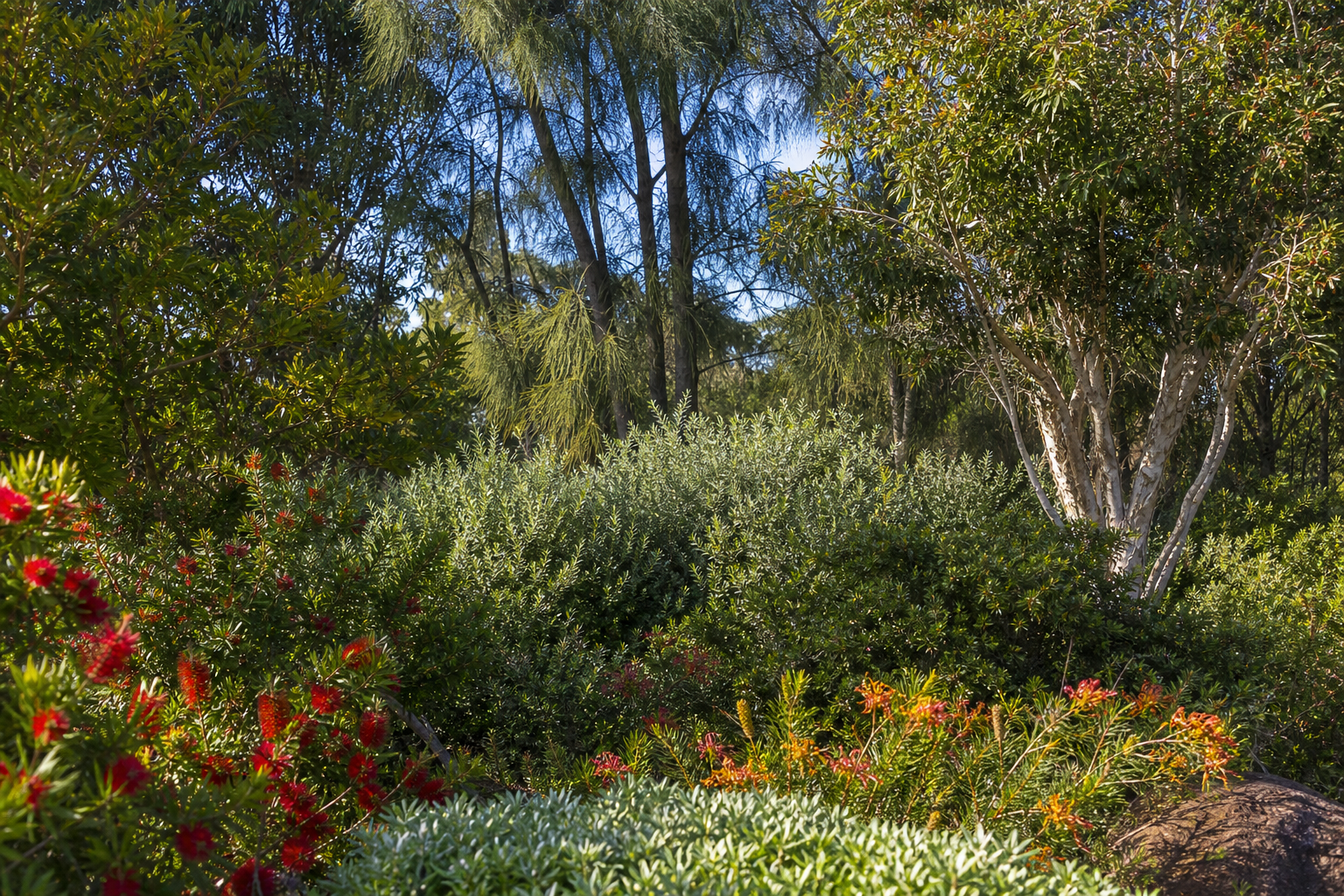
The most effective native screens imitate natural bushland by combining multiple vegetation layers.
Begin with taller trees forming the upper canopy.
Below these, establish medium-height shrubs to provide the primary screening.
Finally, introduce compact shrubs and groundcovers that eliminate gaps near ground level.
This layered approach delivers superior privacy while allowing filtered airflow. It also creates habitat complexity, supporting birds, insects, reptiles, and other beneficial wildlife.
Instead of appearing artificial, the planting becomes richly textured and visually dynamic.
Planting for Long-Term Success
The strongest native screens begin with careful establishment.
Prepare planting areas by removing weeds and improving soil structure where necessary.
Dig generous planting holes, ensuring the root ball sits level with the surrounding soil. Avoid planting too deeply, as this can impede healthy root development.
Spacing deserves careful thought.
Plants positioned too closely compete for moisture and nutrients. Too far apart, and screening takes years to develop.
During the first year:
- Water deeply and consistently.
- Apply organic mulch to conserve moisture.
- Protect young plants from competition by controlling weeds.
Early attention produces vigorous, self-sustaining growth later.
Maintaining Healthy Native Screens
Maintenance is surprisingly straightforward.
Regular tip pruning encourages branching, resulting in denser foliage and improved screening.
Rather than performing severe annual pruning, lightly trim plants several times during active growth. This maintains natural form while increasing privacy.
Mulch annually to retain soil moisture and regulate temperature.
Where fertiliser is required, choose formulations suitable for Australian natives, particularly for phosphorus-sensitive species.
Healthy plants naturally resist many pests and diseases, reducing the need for chemical intervention.
Creating Wildlife-Friendly Boundaries
One of the greatest advantages of native privacy planting is its ecological contribution.
Flowering bottlebrushes provide nectar for honeyeaters.
Grevilleas sustain bees and butterflies.
Dense shrubs create nesting sites for small birds, while taller trees offer shelter throughout the year.
Instead of a sterile fence line, your garden becomes a living ecosystem.
Each flowering season introduces new visitors. Birds arrive with the morning light. Butterflies drift between blossoms. Native bees quietly pollinate the landscape.
The boundary itself becomes alive.
Conclusion
Australian native plants offer far more than privacy.
They soften architecture, moderate wind, reduce noise, attract wildlife, and create gardens that feel naturally connected to the surrounding landscape.
By combining trees, shrubs, and groundcovers into layered plantings, you can establish living screens that become more beautiful with every passing year.
The result is not simply a boundary.
It is a landscape that protects, welcomes, and evolves—a thriving green sanctuary that delivers privacy, comfort, and enduring Australian character.