How to Plant and Care for Trees in SEQ Gardens
 Trevor Dixon
1. Introduction
A tree is never just a tree. It is shade, shelter, structure, and story. In South East Queensland, where heat, humidity, and seasonal extremes shape every garden, planting a tree is an investment measured not in months—but in decades.
Success begins at the very start. Poor planting leads to years of struggle. Thoughtful planting leads to generations of growth.
2. Understanding South East Queensland Conditions
Climate Patterns and Seasonal Influences
SEQ is defined by contrast. Summers arrive with intensity—humid, storm-laden, and often unforgiving. Winters, by comparison, are gentle and dry. These oscillations influence everything from root development to nutrient uptake.
Trees must endure both saturation and scarcity. They must thrive in abundance and survive in restraint.
Soil Types and Drainage Challenges
Soils across SEQ vary dramatically. Sandy coastal soils drain rapidly but lack nutrients. Clay soils retain moisture yet risk compaction and waterlogging.
Understanding your soil is essential. It determines how roots breathe, how water moves, and how nutrients are retained.
3. Choosing the Right Tree for Your Garden
Matching Species to Space and Purpose
Every tree has a destiny written into its genetics. Height. Width. Root spread. Growth rate.
A tree chosen without foresight becomes a problem. One chosen wisely becomes an asset. Consider:
- Available space above and below ground
- Desired function—shade, screening, feature
- Proximity to structures, pipes, and pathways
Native vs Exotic Considerations
Native trees often adapt seamlessly to SEQ’s climate. They require less intervention and support local ecosystems. Exotic species, however, may offer unique aesthetics or faster growth.
The best choice balances beauty with practicality.
4. Preparing the Planting Site
Soil Preparation and Improvement
Good soil is alive. It breathes. It supports. It nourishes.
Before planting, loosen compacted soil and incorporate organic matter such as compost. This improves structure, enhances drainage, and encourages beneficial microbial life.
Positioning for Sunlight, Wind, and Drainage
Light is energy. Too little, and growth falters. Too much, and stress emerges.
Position trees where they receive appropriate sunlight and protection from harsh winds. Avoid low-lying areas where water collects—roots suffocate in stagnant conditions.
5. The Correct Planting Technique
Digging the Hole and Root Placement
Dig a hole twice as wide as the root ball, but no deeper. Depth matters. Planting too deep is one of the most common and damaging mistakes.
Place the tree so the root collar sits level with or slightly above the surrounding soil.
Backfilling, Staking, and Initial Watering
Backfill gently, eliminating air pockets without compacting the soil excessively. Stake only if necessary, allowing some movement to encourage strong trunk development.
Water deeply. This is not a sprinkle—it is a saturation that settles soil and hydrates roots.
6. Watering Strategies for SEQ Trees
Establishment Phase vs Mature Trees
Young trees demand attention. Frequent, deep watering helps roots expand outward into surrounding soil.
Mature trees, by contrast, require less frequent watering but benefit from deep soaking during prolonged dry periods.
Managing Drought and Heavy Rainfall
SEQ presents both extremes. During drought, mulch and deep watering are critical. During heavy rain, ensure drainage is adequate to prevent root rot.
Balance is everything.
7. Mulching and Soil Health
Benefits of Organic Mulch
Mulch is the unsung hero of tree care. It conserves moisture, moderates soil temperature, and suppresses weeds.
Maintaining Moisture and Soil Biology
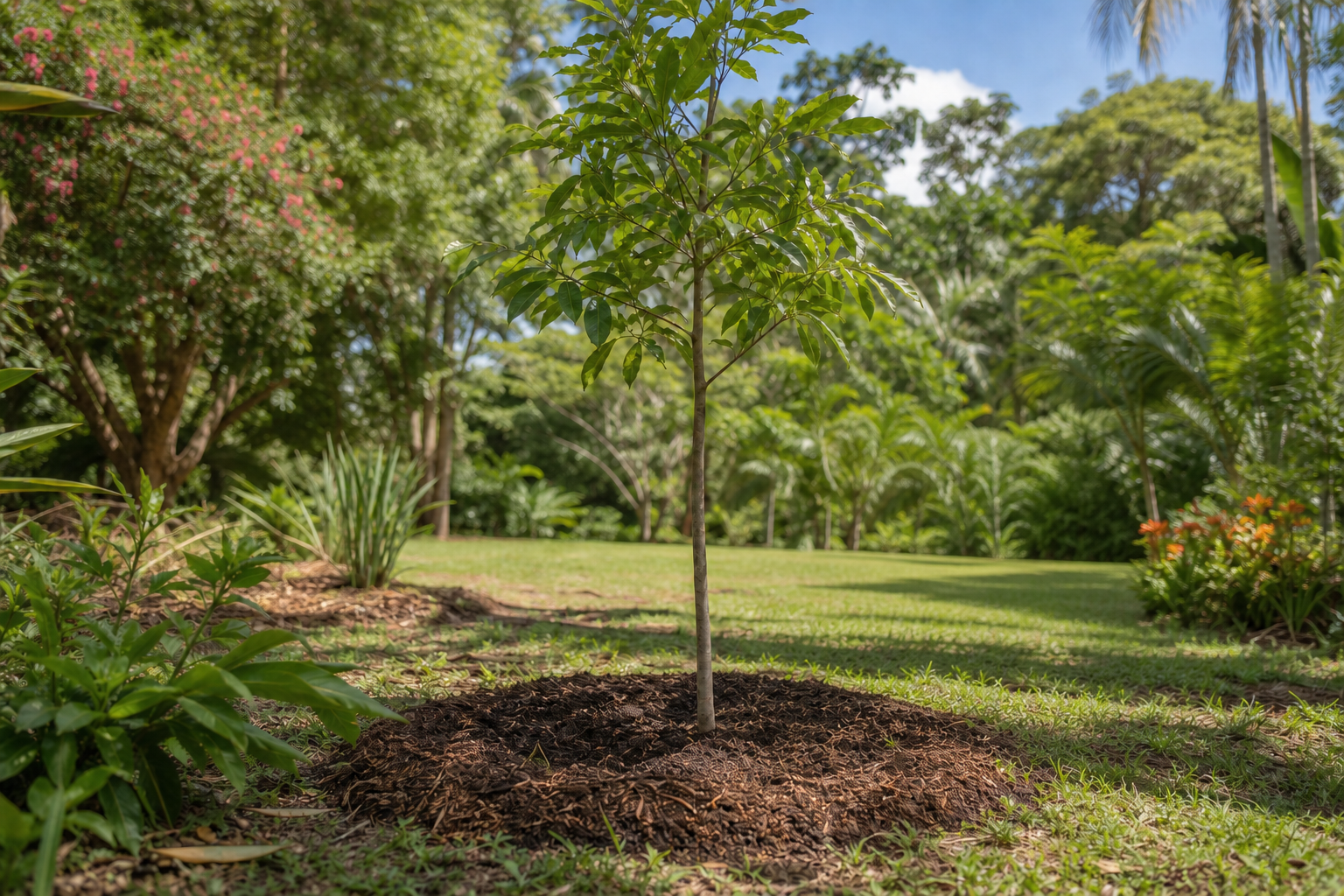
Apply mulch in a broad ring around the tree, avoiding contact with the trunk. Over time, it breaks down, enriching the soil and feeding the ecosystem beneath.
8. Fertilising for Healthy Growth
When and How to Fertilise
Fertilising should complement, not replace, healthy soil. Apply during active growth periods—typically spring and early summer.
Choosing the Right Nutrients
Select fertilisers suited to the species. Native trees often require low-phosphorus formulations, while others benefit from balanced blends.
Less is often more. Excess fertiliser can harm roots and disrupt growth.
9. Pruning and Structural Development
Early Shaping for Strong Structure
The first few years define the tree’s architecture. Remove weak, crossing, or competing branches to encourage a strong central structure.
Ongoing Maintenance Pruning
Pruning is refinement, not aggression. Done correctly, it enhances form, improves airflow, and reduces risk of breakage.
10. Pest and Disease Management
Common Issues in SEQ Gardens
Warm, humid conditions encourage pests and fungal diseases. Aphids, scale insects, and leaf spot are common challenges.
Preventative Care and Natural Solutions
Healthy trees resist problems better than stressed ones. Maintain soil health, avoid overwatering, and encourage beneficial insects.
Early intervention prevents escalation.
11. Seasonal Care Guide
- Summer: Deep watering, mulch maintenance, stress monitoring
- Autumn: Soil improvement, light pruning, planting preparation
- Winter: Minimal intervention, structural pruning
- Spring: Fertilising, new planting, growth support
Each season demands a different rhythm. Respond accordingly.
12. Common Mistakes to Avoid
- Planting too deep
- Overwatering or underwatering
- Choosing unsuitable species
- Ignoring mature size
- Neglecting soil preparation
Mistakes compound over time. Precision at the beginning prevents problems later.
13. Long-Term Tree Care and Monitoring
Signs of Stress or Decline
Yellowing leaves, stunted growth, dieback—these are signals. Trees communicate through their condition.
Ensuring Longevity and Resilience
Regular observation allows early correction. Healthy trees become increasingly self-sufficient, anchoring the landscape with strength and stability.
14. Conclusion
Planting a tree in South East Queensland is an act of foresight. It requires patience, knowledge, and care—but the rewards are profound.
Shade deepens. Air cools. Wildlife returns.
And over time, what began as a simple planting becomes something far greater—a living structure, rooted in place, growing stronger with every passing season.